Here’s former US President Barack Obama in a tan suit. I drew this as part of a larger project for Learning A-Z.
You might remember that there was a brief, silly controversy about President Obama wearing this tan suit because on a slow news day some people thought it did not look presidential. Originally, this illustration had him in a black suit, but the client was concerned that the project had too many historic figures in dark suits already. They wanted a little more variety, which was somewhat challenging since men’s formalwear is not really particularly varied. But then I remembered the silliness about the tan suit and I thought this would be the perfect solution. More about President Obama can be found here.
This is the second time I’ve drawn Martin Luther King Jr. (1929 – 1968) the famed civil rights activist. This is one of several significant historical figures drawn for a larger project for Learning A-Z.
He was a Baptist minister and a civil rights activist who was assassinated on April 4, 1968. He was known for his emphasis on using non-violent protest and civil disobedience to challenge the racist and discretionary laws of his time. More information can be found here.
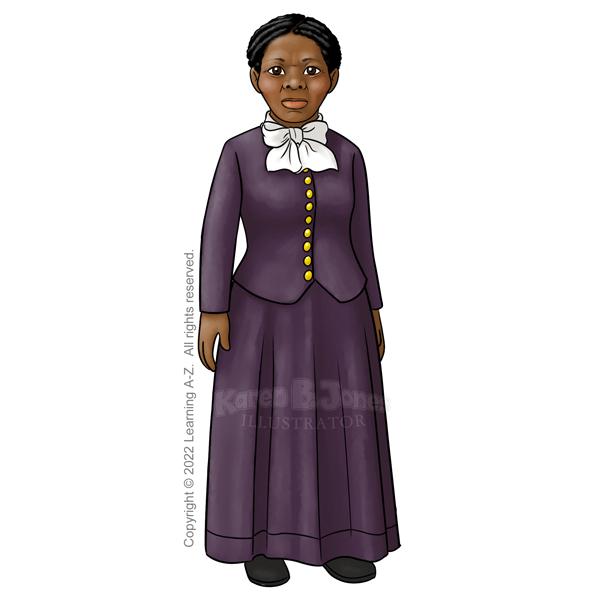
Harriet Tubman (1822-1913) was an American abolitionist best known for her association with the Underground Railroad, the secret network of safehouses run by abolitionist activists to help slaves escape to free states, territories, and British North America (now Canada). Originally named Araminta Ross, she was born into slavery. After she escaped in 1849, she personally led an estimated 70 others to freedom as a conductor on the Underground Railroad. During the Civil War, she was a nurse, scout, and spy for the Union army. Later she was an activist for women’s suffrage and established the Harriet Tubman Home for the Elderly. More information about her life can be found here.
This illustration was created for Learning A-Z as part of a larger project. I used black and white photographs as references, but the quality of the surviving images were not ideal.
Have you ever noticed that in the earliest black and white photos, the subjects always had very serious, sometimes even unpleasant, expressions on their faces? This is because early film wasn’t very light sensitive and required the subjects to stay perfectly still for a fairly long time. Sometimes for several minutes. Sometimes in bright sunlight. It’s difficult to hold a smile that long, so they usually didn’t. The reference photos I had of Tubman all left me with the impression that she was perpetually annoyed. But, since that’s probably the fault of the photographic technology rather than a true reflection of reality, I toned it down quite a bit. Still, I didn’t want to go too far and make her smiley instead. I settled for something fairly neutral.
Our next historical figure (or celebrity, depending on how you categorize him) is Jackie Robinson. He was the first black baseball player in Major League Baseball. He played for the Brooklyn Dodgers and earned many accolades throughout his baseball career. Although he’s most famous for breaking the color line in MLB, he had a long history of activism throughout his life. More information on him can be found here.
I did my best to match the historical details of the uniform as well as to get the likeness reasonably accurate.
This boy is walking with forearm crutches. I was to draw him as if he were walking to school wearing a backpack. I actually kind of like drawing backpacks, for some reason.
Here’s the first interior page of the picture book I just finished for Entrepreneur Media, Inc. This image will have text overlaid over the sky and maybe the tops of the buildings. This is a nice spring day.
This week I finished illustrations for a new picture book for Entrepreneur Media Inc. Here’s a mock-up of the cover. The final text will be formatted a little different, probably a different font, but this gives you the idea.
A little behind-the-scenes detail: I originally had a different cover design concept in mind (below) but the client wanted this one (above) because they wanted to show everyone on both teams and didn’t want them to look aggressive.
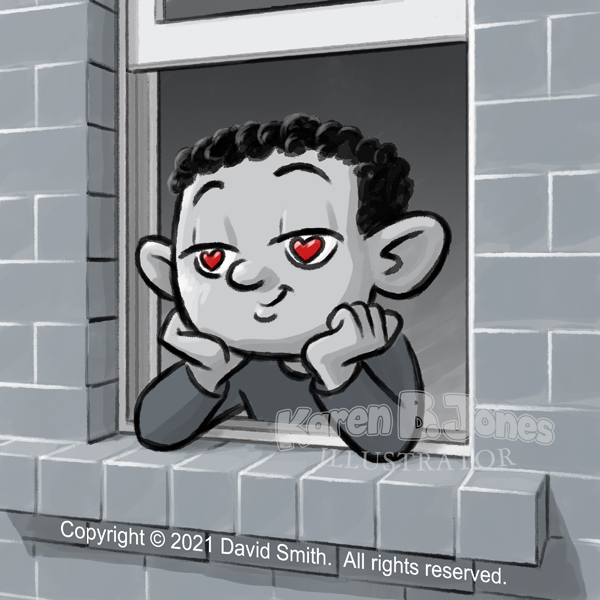
Here’s a recent commission for rap artist, David Smith, who goes by the stage name Dave 3X3. This image is to be used for an upcoming album cover. He was wonderful to work with.
Good luck to you, Dave!
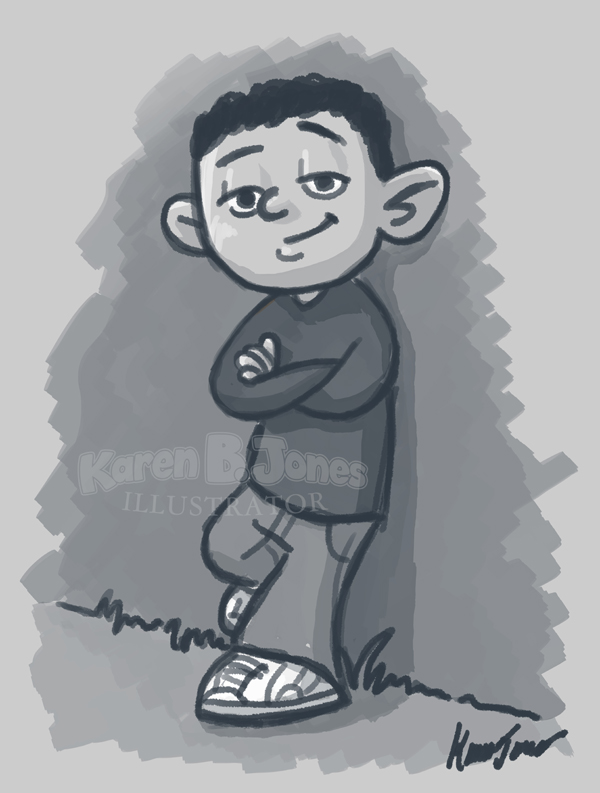
This image (above) was based on an earlier image (below) from 2013 with the same character. You’ll notice these aren’t drawn in my typical style. The first was one of my experiments, playing with different ideas. Then I matched the style (and refined it just a little) for the new commission. I like playing with different ideas, and sometimes they even lead to new opportunities.
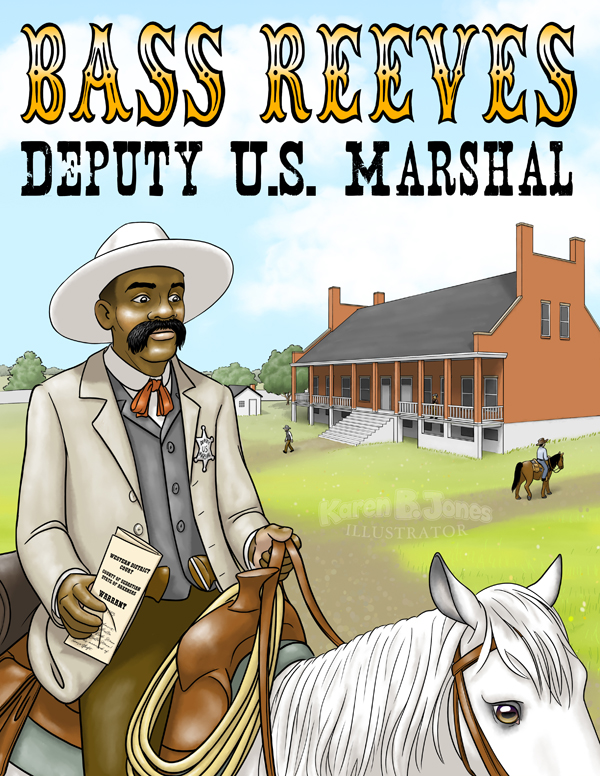
Here’s an illustration of Deputy US Marshal Bass Reeves riding out of Fort Smith, Arkansas with a warrant in hand. Bass Reeves was the first black Deputy US Marshal west of the Mississippi. He is thought to be the real-life inspiration for The Lone Ranger. He did not have an Indian sidekick named Tonto (which is offensive on a couple of levels) but he did have friends among the indigenous tribes living in the Oklahoma and Indian Territories. The story is that he fled to Oklahoma Territory after he learned about his emancipation from slavery after the Civil War. There he learned several native languages and how to shoot and track. Those skills and contacts, along with his own ingenuity, later helped him track down the outlaws he was charged with capturing as a Deputy US Marshal. Upon his retirement, he had over 3,000 arrests of felons on his record and had killed 14 outlaws, an impressive tally which inspired many stories.
I used some artistic license to give him a white horse, like The Lone Ranger, and the traditional white hat of the western hero. The Fort Smith courthouse is drawn how it looked sometime in the 1870s. I used several reference photos for both the courthouse and Bass Reeves himself.
The font I used on the bottom is named Nashville and designed by Disturbed Type. I like the eroded look to it. I hand drew the letters for his name using the font Tagwood by Intellecta Design as a guide.





 Karen B. Jones - Illustrator