Here’s former US President Barack Obama in a tan suit. I drew this as part of a larger project for Learning A-Z.
You might remember that there was a brief, silly controversy about President Obama wearing this tan suit because on a slow news day some people thought it did not look presidential. Originally, this illustration had him in a black suit, but the client was concerned that the project had too many historic figures in dark suits already. They wanted a little more variety, which was somewhat challenging since men’s formalwear is not really particularly varied. But then I remembered the silliness about the tan suit and I thought this would be the perfect solution. More about President Obama can be found here.
Continuing with our subset of illustrations of historical figures for Learning A-Z, this one is an illustration of Maria Tallchief, one of America’s first prima ballerinas and an Indigenous American. She was best known for her performance dancing the lead in “The Firebird” in 1949. More information about her can be found here.
The client wanted her pictured in something similar to her costume in “The Firebird”. But they didn’t want her in exactly that costume for copyright reasons. So, this costume is intentionally simpler than the iconic costume, but in the same color. Because all the images in this project were a standard height (the art itself, not the characters) I did have a bit of a problem with those feathers. They really should have been standing straight up, but that would have caused some problems if I had. Either I’d have had to make this one image taller than the standard size, which would throw off the layout, or I’d have to make this one character in a smaller scale than the rest of the characters, or I could make shorter feathers. When given these choices, the client decided to let the feathers hang sideways like this.
We’re done with professions. Now we’re moving onto historical figures. First up is Frida Khalo.
She was a famous in influential Mexican folk artist. More information on her can be found here.
When I draw figures who need to look like specific, real-life people, I use lots of references. I need the references to make sure that the likenesses at least resemble the real person, but I also have to be very careful not to outright copy any of the references because it’s important to respect everyone’s copyrights. It can be a little tricky when you’re trying to make them look recognizably like them, but not exactly like that particular reference photo or painting of them.
I had references for her face, hair, a tutorial on how she did the thing where she braided her scarf into her hair, and several photos of her in various outfits. The outfit she’s wearing here is not anything she was ever pictured in and probably never actually wore, but it has elements of outfits from reference photos. Color references were particularly useful, since so many of her photos were black and white. In all, the process is a bit like a collage.
Here’s an illustration of a police officer in uniform. This is the last illustration for the set of images depicting people in recognizable professions. This was made as part of a larger commission for the children’s educational publisher Learning A-Z.
One detail when drawing police for the children’s market is that you want to be careful about depicting guns. This might sound like a silly concern to have, but children’s publishing tends to be very sensitive about showing weapons. Particularly for the younger age ranges. Normally you just wouldn’t draw guns at all, but police in America are pretty much always armed. It would be weird to show them with an empty belt. It just wouldn’t quite look like a cop. But you also don’t want to show the weapon too blatantly for your audience. To solve this problem, I like to draw police officers turned slightly away from the viewer so that their hip holster is on the far side, either partially or completely hidden from view. In this case, she’s facing the viewer almost full-on, but her hand position obscures those blocky items on her belt. Undoubtedly one of those is her firearm, but it’s not too obvious.
This is a cartoon illustration of a commercial airline pilot in her traditional uniform. It was part of a larger commission for Learning A-Z. This set depicts diverse people with recognizable occupations.
I was pleased that this one called for a woman with short hair, since we hadn’t had many of those so far in the project. I also kept forgetting to add jewelry to people, since it was rarely mentioned in the specs. For this one I made a point to give her earrings and a wedding ring to make up for that previous oversight. I don’t remember why she didn’t get a pilot’s hat, but there was probably a reason.
Did you know that there is a reason the flight crew greets the passengers with one hand behind their backs like this? It’s nothing nefarious. They have a little counting device that they use to count the number of passengers that board the plane. They want to make sure it matches the number of tickets scanned. (Either stowaways or missing passengers would be bad.) They keep the device behind their back because they are trying to be discreet about it.
This is a cartoon illustration of a park ranger giving a presentation about a red-tailed hawk. This image is part of a subset of illustrations within the larger project depicting people with recognizable professions. The project was commissioned by Learning A-Z to be used in a Build-A-Book application for children. As always, the image was created digitally in Adobe Photoshop using my cintiq tablet.
This one was fun to draw because I used a photo reference from my own personal photos. This hawk is based on the one that came by years ago and perched on my back fence for several hours. It was a very good model and let me get very close to get some nice shots. So, drawing this brought to mind a memory of a really special afternoon for me.
This final image was also way different than the original specs. Originally, this was supposed to be a woman park ranger with a park map she was pointing to. But that pose was fairly unworkable if we wanted to both see the content of the map and have the woman viewed from the front, looking at the viewer at eye-level. Which they did. Also, holding an unfolded paper map usually requires two hands, then a third would be needed to point. Additionally, the specs for this section were too heavy on women, and we already had a Middle Eastern woman with a prosthetic leg previously in the project. That was why it was decided to switch this one to a man.
It was my suggestion to change the pose to the park ranger doing a nature presentation with an animal, which the client liked. I suggested several animals, but I was really hoping they’d go for the hawk. Which they did.
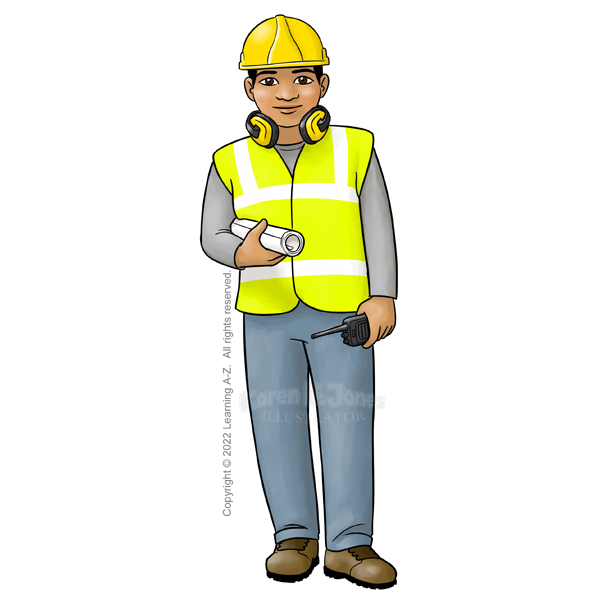
A cartoon illustration of a construction worker or contractor. He’s got the safety vest, helmet, ear protection, walkie talkie, probably even steel-toed boots. I think he’s the contractor, since he’s carrying the plans.
A chef. Probably from a more upscale restaurant, if they’re wearing the traditional chef’s uniform.
This is image 138 of 150 images commissioned for Learning A-Z. Each one is a cartoon drawing of a person isolated on white. Diversity was a key priority in the series and so the characters represent many different races, ethnic groups, genders, ages, and included individuals with visible disabilities. Previous batches were focused mostly on children, but this batch are all adults.
Sorry for the delayed posts this last week. Life happens and we’ve been dealing with a family medical emergency requiring last-minute, out-of-town travel and hours waiting around in a hospital. Good news is the relative made it through the scary part we were all afraid they wouldn’t.
So… Getting back on schedule…
Here’s a bird-watcher girl. She’s got her binoculars and her birding book. Looks like she’s all set.






 Karen B. Jones - Illustrator