I recently completed a commission for an illustration of a little indigenous boy performing as a grass dancer. The client advised me on what details to include to make him look authentic, since she is indigenous and I am not. She wanted it to match that illustration I made a few years ago of a girl in a jingle dress.
Continuing with our subset of illustrations of historical figures for Learning A-Z, this one is an illustration of Maria Tallchief, one of America’s first prima ballerinas and an Indigenous American. She was best known for her performance dancing the lead in “The Firebird” in 1949. More information about her can be found here.
The client wanted her pictured in something similar to her costume in “The Firebird”. But they didn’t want her in exactly that costume for copyright reasons. So, this costume is intentionally simpler than the iconic costume, but in the same color. Because all the images in this project were a standard height (the art itself, not the characters) I did have a bit of a problem with those feathers. They really should have been standing straight up, but that would have caused some problems if I had. Either I’d have had to make this one image taller than the standard size, which would throw off the layout, or I’d have to make this one character in a smaller scale than the rest of the characters, or I could make shorter feathers. When given these choices, the client decided to let the feathers hang sideways like this.
Here’s an illustration of a police officer in uniform. This is the last illustration for the set of images depicting people in recognizable professions. This was made as part of a larger commission for the children’s educational publisher Learning A-Z.
One detail when drawing police for the children’s market is that you want to be careful about depicting guns. This might sound like a silly concern to have, but children’s publishing tends to be very sensitive about showing weapons. Particularly for the younger age ranges. Normally you just wouldn’t draw guns at all, but police in America are pretty much always armed. It would be weird to show them with an empty belt. It just wouldn’t quite look like a cop. But you also don’t want to show the weapon too blatantly for your audience. To solve this problem, I like to draw police officers turned slightly away from the viewer so that their hip holster is on the far side, either partially or completely hidden from view. In this case, she’s facing the viewer almost full-on, but her hand position obscures those blocky items on her belt. Undoubtedly one of those is her firearm, but it’s not too obvious.
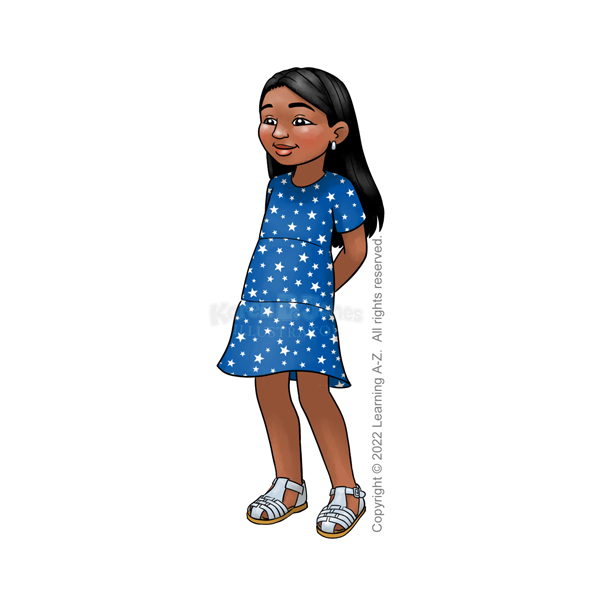
Back to this Learning A-Z project. As a reminder, this is a set of 150 diverse characters of various ages and body types, isolated on white. Here we’re starting back on batch 4. (There are 10 batches, total.) This batch are all Indigenous Americans.
This little girl is wearing a sweater with a traditional pattern.
So, I’m working on a series for my portfolio in my spare time. It revolves around the girl on the right and her middle school friends. She was also in the selfie pic I posted earlier.
I hesitated to put this one up now, before I’ve finished more of the series, because it’s pretty negative and the series isn’t supposed to be negative.
I was kind of in a mood when I drew it.
I promise she’s not normally a kid that gets in fights.
This was just a really bad day for her.
The next one will be more pleasant.
I promise.
I actually chose this pose to show some action, to show the two figures directly interacting with each other in a realistic pose, to show angry expressions, and to oppose the stereotypes that only boys ever fight.
Here’s a recent piece for Learning A-Z. The waiting room in a veterinarian’s office. The unusual clientele is because this is for the educational market. The words for the animals (except for the cat) all have unusual plural forms. Wolf/wolves, sheep/sheep, goose/geese, mouse/mice.