This is the last one! 150 characters, isolated on white, created for a large project for Learning A-Z.
Here’s Abraham Lincoln, 16th president of the United States (1809-1865). He was president during the US Civil War and was assassinated on April 15, 1865. He is best known for abolishing slavery in the US. More about him here.
Here’s former US President Barack Obama in a tan suit. I drew this as part of a larger project for Learning A-Z.
You might remember that there was a brief, silly controversy about President Obama wearing this tan suit because on a slow news day some people thought it did not look presidential. Originally, this illustration had him in a black suit, but the client was concerned that the project had too many historic figures in dark suits already. They wanted a little more variety, which was somewhat challenging since men’s formalwear is not really particularly varied. But then I remembered the silliness about the tan suit and I thought this would be the perfect solution. More about President Obama can be found here.
This is the second time I’ve drawn Martin Luther King Jr. (1929 – 1968) the famed civil rights activist. This is one of several significant historical figures drawn for a larger project for Learning A-Z.
He was a Baptist minister and a civil rights activist who was assassinated on April 4, 1968. He was known for his emphasis on using non-violent protest and civil disobedience to challenge the racist and discretionary laws of his time. More information can be found here.
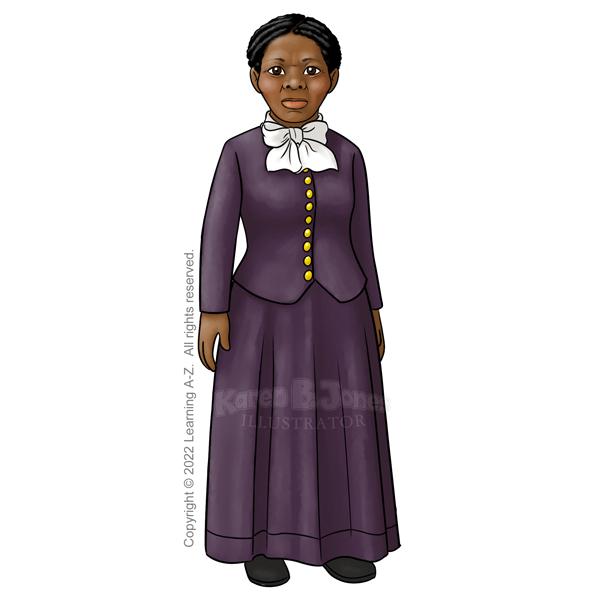
Harriet Tubman (1822-1913) was an American abolitionist best known for her association with the Underground Railroad, the secret network of safehouses run by abolitionist activists to help slaves escape to free states, territories, and British North America (now Canada). Originally named Araminta Ross, she was born into slavery. After she escaped in 1849, she personally led an estimated 70 others to freedom as a conductor on the Underground Railroad. During the Civil War, she was a nurse, scout, and spy for the Union army. Later she was an activist for women’s suffrage and established the Harriet Tubman Home for the Elderly. More information about her life can be found here.
This illustration was created for Learning A-Z as part of a larger project. I used black and white photographs as references, but the quality of the surviving images were not ideal.
Have you ever noticed that in the earliest black and white photos, the subjects always had very serious, sometimes even unpleasant, expressions on their faces? This is because early film wasn’t very light sensitive and required the subjects to stay perfectly still for a fairly long time. Sometimes for several minutes. Sometimes in bright sunlight. It’s difficult to hold a smile that long, so they usually didn’t. The reference photos I had of Tubman all left me with the impression that she was perpetually annoyed. But, since that’s probably the fault of the photographic technology rather than a true reflection of reality, I toned it down quite a bit. Still, I didn’t want to go too far and make her smiley instead. I settled for something fairly neutral.
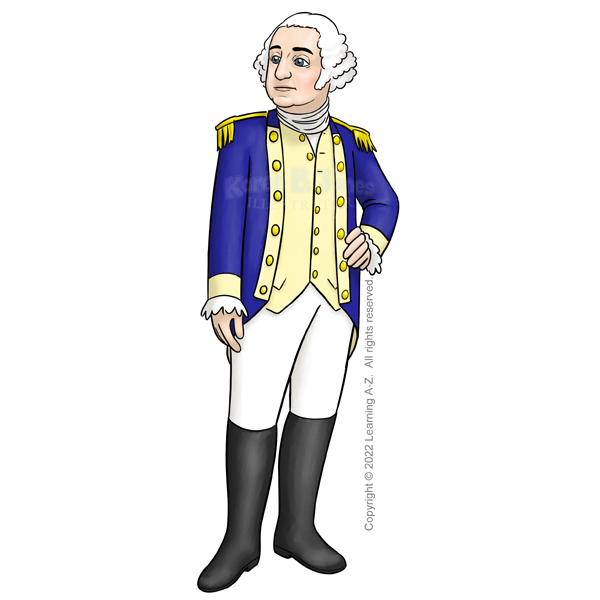
Here’s our first president, George Washington. There were no photo references, of course, but there are quite a few paintings available that I was able to use as references. Again, this is an image created on commission for Learning A-Z.
Our next historical figure (or celebrity, depending on how you categorize him) is Jackie Robinson. He was the first black baseball player in Major League Baseball. He played for the Brooklyn Dodgers and earned many accolades throughout his baseball career. Although he’s most famous for breaking the color line in MLB, he had a long history of activism throughout his life. More information on him can be found here.
I did my best to match the historical details of the uniform as well as to get the likeness reasonably accurate.
Continuing with our subset of illustrations of historical figures for Learning A-Z, this one is an illustration of Maria Tallchief, one of America’s first prima ballerinas and an Indigenous American. She was best known for her performance dancing the lead in “The Firebird” in 1949. More information about her can be found here.
The client wanted her pictured in something similar to her costume in “The Firebird”. But they didn’t want her in exactly that costume for copyright reasons. So, this costume is intentionally simpler than the iconic costume, but in the same color. Because all the images in this project were a standard height (the art itself, not the characters) I did have a bit of a problem with those feathers. They really should have been standing straight up, but that would have caused some problems if I had. Either I’d have had to make this one image taller than the standard size, which would throw off the layout, or I’d have to make this one character in a smaller scale than the rest of the characters, or I could make shorter feathers. When given these choices, the client decided to let the feathers hang sideways like this.
We’re done with professions. Now we’re moving onto historical figures. First up is Frida Khalo.
She was a famous in influential Mexican folk artist. More information on her can be found here.
When I draw figures who need to look like specific, real-life people, I use lots of references. I need the references to make sure that the likenesses at least resemble the real person, but I also have to be very careful not to outright copy any of the references because it’s important to respect everyone’s copyrights. It can be a little tricky when you’re trying to make them look recognizably like them, but not exactly like that particular reference photo or painting of them.
I had references for her face, hair, a tutorial on how she did the thing where she braided her scarf into her hair, and several photos of her in various outfits. The outfit she’s wearing here is not anything she was ever pictured in and probably never actually wore, but it has elements of outfits from reference photos. Color references were particularly useful, since so many of her photos were black and white. In all, the process is a bit like a collage.
Here’s an illustration of a police officer in uniform. This is the last illustration for the set of images depicting people in recognizable professions. This was made as part of a larger commission for the children’s educational publisher Learning A-Z.
One detail when drawing police for the children’s market is that you want to be careful about depicting guns. This might sound like a silly concern to have, but children’s publishing tends to be very sensitive about showing weapons. Particularly for the younger age ranges. Normally you just wouldn’t draw guns at all, but police in America are pretty much always armed. It would be weird to show them with an empty belt. It just wouldn’t quite look like a cop. But you also don’t want to show the weapon too blatantly for your audience. To solve this problem, I like to draw police officers turned slightly away from the viewer so that their hip holster is on the far side, either partially or completely hidden from view. In this case, she’s facing the viewer almost full-on, but her hand position obscures those blocky items on her belt. Undoubtedly one of those is her firearm, but it’s not too obvious.
This is a cartoon illustration of a commercial airline pilot in her traditional uniform. It was part of a larger commission for Learning A-Z. This set depicts diverse people with recognizable occupations.
I was pleased that this one called for a woman with short hair, since we hadn’t had many of those so far in the project. I also kept forgetting to add jewelry to people, since it was rarely mentioned in the specs. For this one I made a point to give her earrings and a wedding ring to make up for that previous oversight. I don’t remember why she didn’t get a pilot’s hat, but there was probably a reason.
Did you know that there is a reason the flight crew greets the passengers with one hand behind their backs like this? It’s nothing nefarious. They have a little counting device that they use to count the number of passengers that board the plane. They want to make sure it matches the number of tickets scanned. (Either stowaways or missing passengers would be bad.) They keep the device behind their back because they are trying to be discreet about it.





 Karen B. Jones - Illustrator