These two dancers are performing the traditional Mexican Hat Dance. It is Mexico’s national dance and is often performed during Cinco de Mayo celebrations. Again, this is a very small illustration. That’s why the faces are mostly featureless.
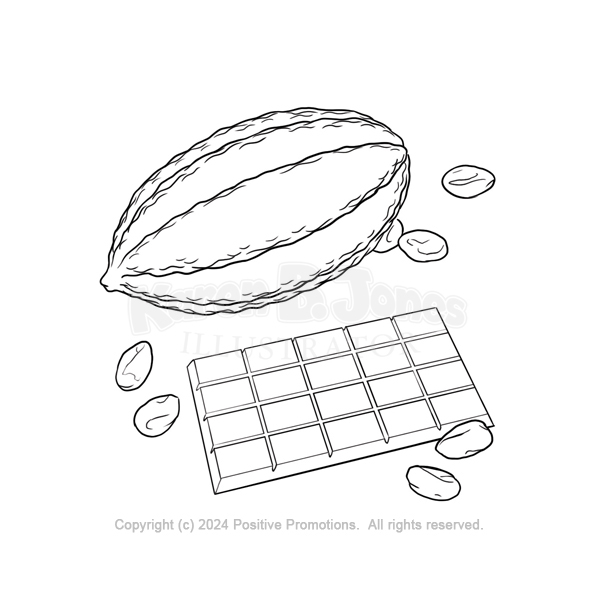
A chocolate bar next to some cocoa beans and a cocoa pod. I hadn’t realized how big these things were until I looked them up. This illustration appears in the book next to a paragraph about chocolate being an example of a food grown in Latin America.
To get the full effect on this one, imagine it is hanging from one of the letters in the page header. It was tied, if I remember right, to the bottom of an “E”. There are three different depictions of pinatas in this book, all of them star-shaped.
Here’s the first interior illustration for Positive Promotion’s Hispanic Heritage book. The original art specs called for this illustration to read “Hurray for Hispanic Heritage” in English, which was also the header for this page. I thought that seemed a little redundant and missed a good opportunity to show some Spanish language in an otherwise completely English manuscript. It seemed appropriate given the subject.
Since I don’t speak Spanish, I used Google Translate to find the equivalent phrase in Spanish and gave the client the option to have me use that phrase instead. To be safe, I also warned the client to double-check whether my translation was correct, but I think it’s right. They didn’t correct me, anyway. 🤞
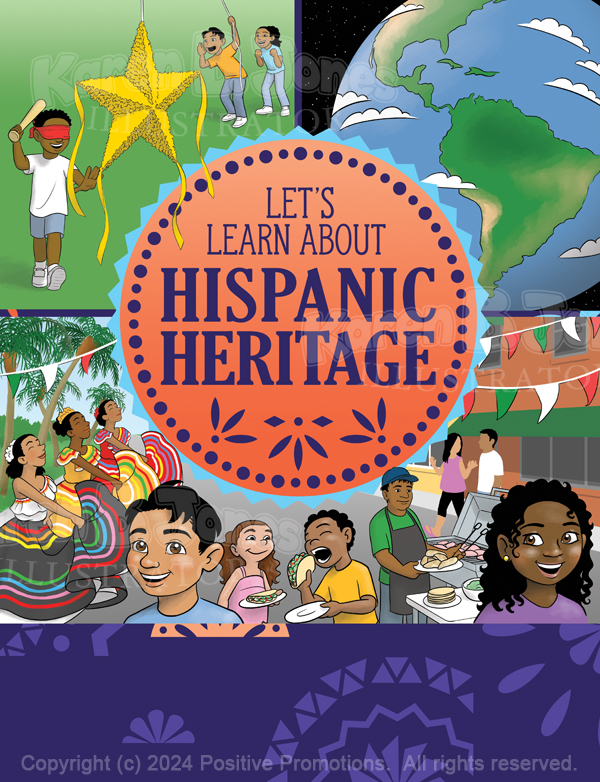
I completed an illustration project for Positive Promotions. I provided illustrations for a children’s workbook about Hispanic Heritage. It’s the sort of thing that might be used in an elementary school for Hispanic Heritage Month or a Spanish language class. This isn’t the final cover, but a mockup based on the draft layout with my illustrations inserted.
Next, I’ll post the line drawings for the interior pages.
We’re done with professions. Now we’re moving onto historical figures. First up is Frida Khalo.
She was a famous in influential Mexican folk artist. More information on her can be found here.
When I draw figures who need to look like specific, real-life people, I use lots of references. I need the references to make sure that the likenesses at least resemble the real person, but I also have to be very careful not to outright copy any of the references because it’s important to respect everyone’s copyrights. It can be a little tricky when you’re trying to make them look recognizably like them, but not exactly like that particular reference photo or painting of them.
I had references for her face, hair, a tutorial on how she did the thing where she braided her scarf into her hair, and several photos of her in various outfits. The outfit she’s wearing here is not anything she was ever pictured in and probably never actually wore, but it has elements of outfits from reference photos. Color references were particularly useful, since so many of her photos were black and white. In all, the process is a bit like a collage.
Last batch. This one’s different from the previous batches. This one’s grouped into two categories. The first half depicts different recognizable professions while the second are all historical figures.







 Karen B. Jones - Illustrator