
Illustrations for Redemption Press
8 of 18
The second panel on page 10 shows people praying outdoors in nature near a tent. This represents another way Jesus says people will pray after they learn his teachings.

The second panel on page 10 shows people praying outdoors in nature near a tent. This represents another way Jesus says people will pray after they learn his teachings.
On page 10 there are two panels showing how people will pray in the future, after they learn what Jesus has to teach. This first panel shows a Samaritan family praying around the table before a meal.

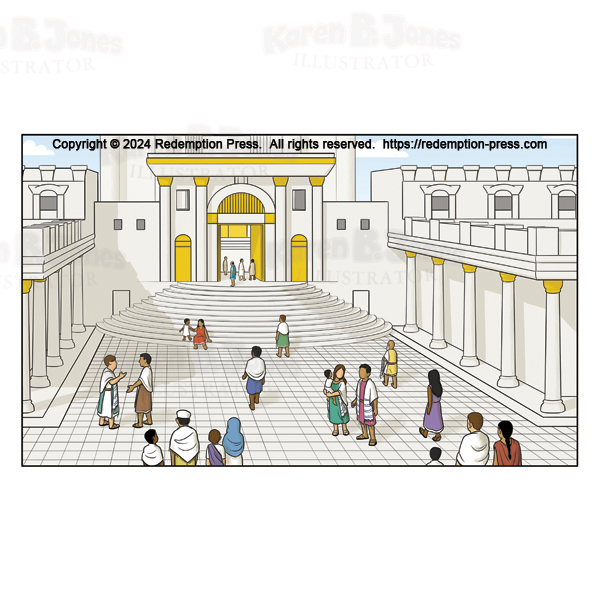
This is the second of two panels on page 9. In the story, Jesus and the woman are discussing how their people pray, and this panel shows how Jewish men pray at The Second Temple. (If you look close, you might notice that only the men are going up into the temple.)
I had to use historical references to draw the temple because the actual temple was destroyed in 70 CE. Luckily, I found some archeological drawings and photos of models depicting what The Second Temple was supposed to have looked like.
Pages 9 and 10 are drawn with panels instead of the two-page spread I’ve used so far. This is the first of two panels on page 9. It shows some Samaritans climbing Mount Gerizim to pray.
In the story, Jesus and the woman are discussing how their people pray, and this panel shows how Samaritans pray three times a year on Mount Gerizim.

Unfortunately, here we’re back to a fairly boring back view of Jesus as he talks to the woman. But it has a pretty view of the scenery. She is now feeling a bit embarrassed about her earlier attitude.

This image was the one I was most proud of in this project. It’s an unusual bird’s-eye view and shows Jesus mostly as a reflection in the water. It’s the most creative way I found to show Him without directly showing Him.
Additionally, in this scene Jesus is talking to the woman about both real and figurative water. (He’s comparing his teachings to eternal water which will sate her figurative thirst forever.) So, showing the water here served the story.

In this second illustration we see the woman speaking to Jesus with an attitude as he holds out his hand. (He is asking for water, and she’s appalled he’s even speaking to her, since she’s a Samaritan and he’s a Jew.)
Notice how only Jesus’ hand and arm are shown? In the previous post about this I explained how the author did not want Jesus depicted directly. The art direction for this panel was to show Jesus holding his hand out to the woman. So, that’s just what I did. Only his hand and arm were really necessary to convey the idea, so that’s all I showed.

Do you see the animals in this panel? To make the story more visually interesting, the author had me hide a butterfly and a frog somewhere on every page. I also included that cat in some of them. The frog and butterfly are both species native to the area around modern-day Israel. The Middle East Tree Frog and The European Common Blue Butterfly. I was more concerned with visibility than accurate sizing, so they’re both drawn larger than they actually are. The cat is just a regular orange tabby.
I recently finished a series of illustrations for a book titled The Wonder At The Well by Vicky Wedel for Redemption Press. By the publisher’s name, you can guess this is a story for the religious market. It tells the biblical story of the Samaritan woman who met Jesus at the well and was so moved by what He said that she immediately went to bring most of her village to come listen to and learn from Him.
Nothing against the story, but it’s not the most visually interesting tale. It’s basically just people talking in every panel. Talking about something that a Christian audience would find very important and inspiring, of course. But still just talking.
However, there was one interesting challenge. I’m sure you’re all aware of the controversy about how to best depict Jesus in art today. Historically, most cultures generally depicted Him as looking like themselves. So, in Asia, He looked Asian. In Africa, He looked black. And in America, He’s usually depicted as white. That’s not necessarily a problem except that, unfortunately, at least in the US, there’s been a lot of White Nationalism that’s become attached to the image of White Jesus. To avoid the stink of that, many Christians here now prefer a more historically accurate Brown Jesus. But not everyone.
To sidestep the whole messy issue, the author on this project decided she just didn’t want His face shown clearly in any of the images. She wanted all back views and obscured views. Nothing straight on with any clear details to his face.
So, the unique challenge for me was to illustrate this story so that it’s not just a series of back views of Jesus. To be clear, there are some back views of Jesus. It couldn’t be avoided. But I’m very proud that I managed to make sure it wasn’t all back views.
Here’s our first one. It shows Jesus’ back, but also the narrator, townspeople, and the town in the distance.

Another thing to note is the speech bubble. This project is drawn using comic book elements including speech bubbles and panels. This panel is a two-page spread with a quarter-inch bleed. I’m not including the text of the manuscript in these art samples, only the art.
I recently completed a project for Utah-based Fish for Garbage, a nonprofit organization that mobilizes communities through waterway cleanups and watershed education. They commissioned me to create a series of illustrations for a children’s activity book.
This image is the second of two hidden picture puzzles. I saved this one until last because it’s my favorite. That’s the same duck from several pages ago. Having him visible both above and below the waterline really sold the idea that he was floating on the water and what was underneath was the underwater view. And just look at those duck feet! So cute!
I’m really not an expert at drawing fish, but I work from references and do my best. The client said the one brown trout I drew had a longer snout than the other, which is actually called a kype and is sought after by fishermen. I don’t really know enough about them to do that intentionally, but I’m so glad it turned out to be a feature and not a bug. Serendipity.
Can you find all 8 items? There’s a cigarette butt, a tin can, a plastic spoon, a plastic drinking straw, a deflated balloon, a deflated inner tube, a plastic bag, and a flip-flop sandal. The client said they find a surprising number of uninflated inner tubes at their cleanup events.
I will say that, between this one and the previous illustration, I spent SO much time drawing little circles for all that gravel. But it was worth it!

I recently completed a project for Utah-based Fish for Garbage, a nonprofit organization that mobilizes communities through waterway cleanups and watershed education. They commissioned me to create a series of illustrations for a children’s activity book.
This image is the first of two a hidden picture puzzles. Can you find all 8 items? There’s a soda bottle, a drink cup, a flip-flop sandal, a chip bag, a soda can, a plastic fork, a deflated balloon, and a set of 6-pack rings. The hidden items were chosen because they’re items often found during the organization’s cleanup events.
This image is a version of the illustration that was used as the cover image. The cover image was in color and without the hidden items. But it still has the same expansive view and variety of wild animals.

 Karen B. Jones - Illustrator