Number 149 of 150

Here’s former US President Barack Obama in a tan suit. I drew this as part of a larger project for Learning A-Z.

You might remember that there was a brief, silly controversy about President Obama wearing this tan suit because on a slow news day some people thought it did not look presidential. Originally, this illustration had him in a black suit, but the client was concerned that the project had too many historic figures in dark suits already. They wanted a little more variety, which was somewhat challenging since men’s formalwear is not really particularly varied. But then I remembered the silliness about the tan suit and I thought this would be the perfect solution. More about President Obama can be found here.

A cartoon illustration of Barack Obama, isolated on white.  He is wearing a tan suit, white dress shirt, gray and tan striped tie, gold wristwatch, and black dress shoes.  He is standing with his arms crossed.   

The image is watermarked with the artist's logo and a line of text noting the client's copyright as, "Copyright (c) 2022 Learning A-Z.  All rights reserved."
Barack Obama

Number 148 of 150

This is the second time I’ve drawn Martin Luther King Jr. (1929 – 1968) the famed civil rights activist. This is one of several significant historical figures drawn for a larger project for Learning A-Z.

He was a Baptist minister and a civil rights activist who was assassinated on April 4, 1968. He was known for his emphasis on using non-violent protest and civil disobedience to challenge the racist and discretionary laws of his time. More information can be found here.

A cartoon illustration of Martin Luther King Jr., isolated on white.  He is standing with one hand raised in a gesture as if speaking. He is wearing a dark blue suit, striped blue tie, white dress shirt, and black dress shoes.  

The image is watermarked with the artist's logo and a line of text noting the client's copyright as, "Copyright (c) 2022 Learning A-Z.  All rights reserved."
Martin Luther King Jr.

Number 145 of 150

Our next historical figure (or celebrity, depending on how you categorize him) is Jackie Robinson. He was the first black baseball player in Major League Baseball. He played for the Brooklyn Dodgers and earned many accolades throughout his baseball career. Although he’s most famous for breaking the color line in MLB, he had a long history of activism throughout his life. More information on him can be found here.

I did my best to match the historical details of the uniform as well as to get the likeness reasonably accurate.

A cartoon illustration of famous baseball player Jackie Robinson isolated on white in his Brooklyn Dodgers Uniform.   He is in an at bat pose, with his bat poised over one shoulder as if waiting for the pitch.  

The image is watermarked with the artist's logo and a line of text noting the client's copyright as, "Copyright (c) 2022 Learning A-Z.  All rights reserved."
Jackie Robinson

Bass Reeves

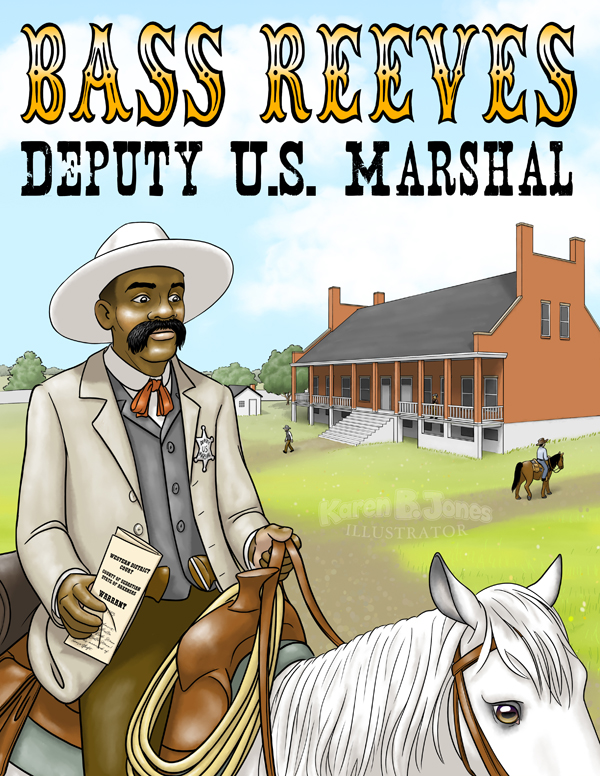
Here’s an illustration of Deputy US Marshal Bass Reeves riding out of Fort Smith, Arkansas with a warrant in hand. Bass Reeves was the first black Deputy US Marshal west of the Mississippi. He is thought to be the real-life inspiration for The Lone Ranger. He did not have an Indian sidekick named Tonto (which is offensive on a couple of levels) but he did have friends among the indigenous tribes living in the Oklahoma and Indian Territories. The story is that he fled to Oklahoma Territory after he learned about his emancipation from slavery after the Civil War. There he learned several native languages and how to shoot and track. Those skills and contacts, along with his own ingenuity, later helped him track down the outlaws he was charged with capturing as a Deputy US Marshal. Upon his retirement, he had over 3,000 arrests of felons on his record and had killed 14 outlaws, an impressive tally which inspired many stories.

I used some artistic license to give him a white horse, like The Lone Ranger, and the traditional white hat of the western hero. The Fort Smith courthouse is drawn how it looked sometime in the 1870s. I used several reference photos for both the courthouse and Bass Reeves himself.

The font I used on the bottom is named Nashville and designed by Disturbed Type. I like the eroded look to it. I hand drew the letters for his name using the font Tagwood by Intellecta Design as a guide.

An illustration of Deputy US Marshal Bass Reeves riding out of Fort Smith, Arkansas with a warrant in hand.  Bass Reeves was the first black Deputy US Marshal west of the Mississippi.